Giant’s Causeway: Marvel at Northern Ireland’s Legendary Wonder
I still remember the first time I stood at the edge of those stones, wind coming straight off the North Atlantic, trying to figure out how something that looked so deliberate could be entirely natural. Giant’s Causeway sits on the north coast of County Antrim, Northern Ireland, and it’s one of those rare places where the science and the folklore both hold up under scrutiny. Roughly 40,000 interlocking basalt columns, most with five or six sides, march down into the sea like a staircase built for something much bigger than a person.

This post may contain affiliate links. Please read our disclosure and privacy policy for more information.
Giant’s Causeway was one of my absolute must-sees on my second journey to Northern Ireland. It is worth visiting for its genuine geological rarity, a legend still told the way it always has been, and stones you can walk on for free. The Visitor Center charges for parking, exhibits, and guided extras, but the coastline and the columns belong to everyone. Between the science, the story of Fionn mac Cumhaill, and the wider Causeway Coast stretching toward the Antrim plateau, there’s enough here to fill a half day or a full one, depending on how far you want to walk.
What Makes This UNESCO Landscape So Special?
Giant’s Causeway earned UNESCO World Heritage status in 1986 because nowhere else combines this scale of columnar basalt with such an intact coastal setting. It was Northern Ireland’s first World Heritage Site and remains one of only three in the UK inscribed purely for natural heritage, not cultural value layered on top.

A World Heritage Site on the Antrim Coast
The site sits on the Antrim Coast where the plateau meets the North Channel, a few miles from Bushmills. It’s a working piece of coastline, not a museum display, with tides and weather still shaping it.
The Basalt Columns and Coastal Scenery
The columns form a honeycomb pattern underfoot, tightly packed and startlingly even, even though they’re entirely the product of cooling lava. Cliffs rise behind them, and the North Atlantic does the rest, throwing spray over the lower stones on rougher days.
Why UNESCO Protects the Site
Beyond the World Heritage designation, most of the property is a National Nature Reserve and sits within an Area of Special Scientific Interest. Seabirds nest on the cliffs, and the National Trust manages the land day to day, balancing foot traffic against a landscape that’s still geologically active in small ways, including slow slope movement along the cliffs.
How Did the Columns Form?
The columns formed from volcanic activity between 50 and 60 million years ago, when lava cooled slowly enough to crack into remarkably regular shapes. It’s a chemistry and physics story more than a geology lecture, and it holds up even on a rainy Tuesday when you’re just trying to keep your footing on wet rock.

Ancient Volcanoes and Lava Flows
An ancient volcano in this part of the North Atlantic sent out thick lava flows that pooled and cooled in stages. Each flow could take years to solidify fully, and the slower the cooling, the more uniform the resulting columns.
Why Most Columns Are Hexagonal
As the lava cooled from the top and bottom at the same time, it contracted and cracked in a pattern that minimizes stress across the surface. Hexagons happen to be the most efficient shape for that kind of even contraction, which is why most columns show five to seven sides rather than random breaks. Geologists have measured and mapped this jointing since the 1700s, and it’s still one of the clearest natural examples of the phenomenon anywhere on Earth.

A Window Into North Atlantic Volcanic Activity
The Causeway is part of a broader record of volcanic activity tied to the opening of the North Atlantic, when Greenland and Europe were pulling apart. That deep-time context is why the site was named among the first 100 IUGS Geological Heritage Sites worldwide.
The Legend of Fionn Mac Cumhaill
Fionn mac Cumhaill, better known outside Ireland as Finn MacCool, is the giant credited with building the Causeway by hand. The story predates any modern visitor center by centuries and comes out of the Fenian Cycle of Irish mythology, later picked up in Scottish and Manx folklore too.
Finn MacCool and the Scottish Rival
In the tale, Finn wanted to reach Scotland to fight a rival giant across the water. Rather than sail, he tore up chunks of the Antrim coastline and laid them across the sea as stepping stones.
Benandonner and the Bridge to Scotland
The rival, Benandonner, turned out to be far bigger than Finn expected. Finn’s wife disguised him as a baby, and when Benandonner saw the size of the “infant,” he fled back across the causeway to Scotland, tearing it up behind him so Finn couldn’t follow. The matching basalt formation at Staffa, off the Scottish coast, is often pointed to as the other end of that broken bridge.
The Giant’s Boot, the Organ, and Other Named Rocks
Walk the shoreline, and you’ll spot named formations tied into the story: the Giant’s Boot, said to have fallen off during the chase, and the Organ, a set of tall columns that resemble pipes. They’re especially worth pointing out to kids, since the names give the geology a story to hang onto.
Plan Your Visit To The Giant’s Causeway
Access to the stones and coastal path is free, while the Visitor Center charges for parking, exhibits, and the shuttle bus. Most people arrive by car or coach from Belfast, Dublin, or Bushmills, and the walk down to the columns is doable for most fitness levels if you take the shuttle one way.
Is Entry Free and What Does the Visitor Center Include?
Walking the causeway itself costs nothing, which surprises many first-time visitors who assume it’s ticketed like an attraction. The paid side covers the Visitor Center building: exhibits on the geology and legend, an audio guide, café, gift shop, and parking. Booking online ahead of time secures a parking slot and speeds up entry, especially in July and August when the car park fills fast.
Getting There From Belfast, Dublin, and Bushmills
From Belfast, it’s about an hour and fifteen minutes by car along the Causeway Coastal Route, or you can take a Translink Ulsterbus service that connects through Coleraine. From Dublin, driving takes closer to three hours each way, so a guided day tour is a more relaxed option than a self-drive round trip. Bushmills is the closest town, just a few miles off, and a good base if you want to split the visit across two days rather than rush it.
Walking Routes, the Shuttle Bus, and Accessibility
The National Trust – Giant’s Causeway Visitor Center manages four designated, color-coded walking trails on-site:

Green Trail Walking Trail
- Difficulty: Easy. It is fully paved, step-free, and specifically designed to be wheelchair- and stroller-accessible.
- Distance & Duration: 0.7 miles to 2 miles depending on loops; takes roughly 30 to 45 minutes.
- Route Overview: This level path runs from the visitor center along the clifftops toward Runkerry Head, offering broad aerial views over the famous rock formations and stretching across to Scotland on clear days.
Blue Trail Walking Trail
- Difficulty: Easy to Moderate. The path is entirely paved, but the return trip involves a long, steep uphill incline that can be physically strenuous. The basalt stones at the end are also famously slippery when wet.
- Distance & Duration: 0.8 miles each way; takes about 20 to 25 minutes to walk down.
- Route Overview: This is the most popular route on site, taking you directly from the visitor center down to the shoreline edge where you can climb onto the 40,000 hexagonal basalt columns. It passes landmarks like the Giant’s Boot and the Wishing Chair.

Red Trail Walking Trail
- Difficulty: Moderate. It follows formal, uneven paths and features the “Shepherd’s Steps”—a steep descent/ascent of 162 narrow stone steps connecting the cliff edges to the coast. It is not suitable for individuals with limited mobility.
- Distance & Duration: 0.8 miles (short loop) to 2 miles (full loop); takes 30 minutes to 1.5 hours depending on your loop choice.
- Route Overview: This trail offers panoramic, bird’s-eye views over the entire causeway from the massive cliffs above. It traverses the upper ridge before dropping down the steps to connect near “The Organ” basalt formation and the lower shoreline paths.
Yellow Trail Walking Trail
- Difficulty: Challenging / Demanding. It involves narrow paths right along open, unfenced cliff edges, dirt or grassy tracks, and uneven coastal terrain.
- Distance & Duration: 1.8 miles for the official site section (part of the larger 33-mile Causeway Coast Way network); takes 1 to 1.5 hours for just this leg.
- Route Overview: This trail traces the outer perimeter of the World Heritage site, running along the high cliffs from Runkerry House in the west to Hamilton’s Seat in the east. It is ideal for experienced hikers trying to escape the heavy crowds.
The main path down to the stones follows the Red Trail, a gentle paved route that most visitors manage without trouble. An accessible shuttle bus runs between the Visitor Center and the stones for anyone who’d rather skip the walk down or the climb back up. For a longer route, the Shepherd’s Steps climb up from the columns to link with the Causeway Coast Way, a proper cliff walk with big coastal views if you’ve got the legs and the weather.
When to Visit and What to Wear
Early morning or late afternoon gives you the stones with fewer people and softer light. Wear sturdy, grippy shoes, since the basalt gets wave-slick even on a dry day, and bring a windproof layer no matter the season. This is a wind-battered stretch of coast, and the weather can turn faster than the forecast suggests.
Making the Most of the Causeway Coast
Giant’s Causeway works best as one stop on a longer run along the Causeway Coast rather than a standalone trip. Adding a couple of nearby stops turns a quick photo visit into a full day that really shows off this part of Antrim.
Add Dunluce Castle, Portrush, and Coleraine
Dunluce Castle sits dramatically on a cliff edge just fifteen minutes east, its ruins half-collapsed into the sea below. Portrush offers beaches, seafood, and a lively harbor if you want a lunch stop, while Coleraine makes a practical hub for rail connections back toward Belfast or Derry.

Combine the Visit With the Dark Hedges or Titanic Belfast
The Dark Hedges, that tunnel of gnarled beech trees, sits about 40 minutes south and pairs well with a Causeway day if you’re driving yourself. On the Belfast end, Titanic Belfast makes a solid bookend for a longer Northern Ireland itinerary, giving you a city-based history stop before or after the coastal drive.
If you do visit Belfast, I highly recommend you take the Tour The Belfast Peace Walls – The Black Cab Tour. The Belfast Peace Walls, also known as the Belfast Peace Lines, separate Catholic and Protestant communities in Belfast, Northern Ireland. The walls were built to curb violence stemming from the 1969 civil unrest. The riots led to a thirty-year conflict known as the Troubles and reflect the civil rights campaign to end discrimination against Catholics and Irish nationalists.
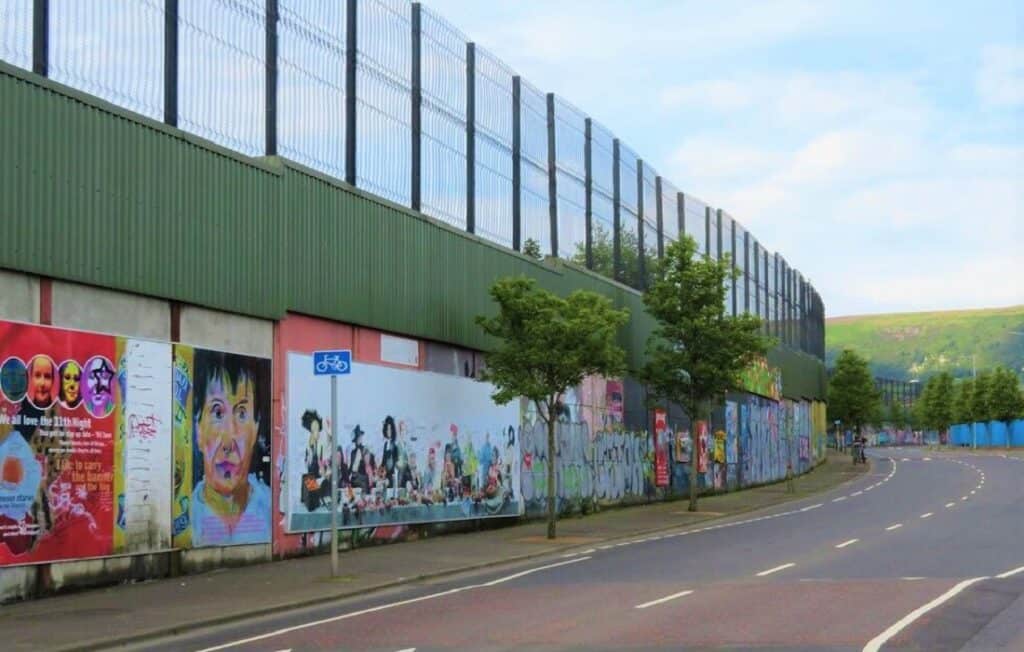
Respecting a Protected Coastline
This coastline carries National Nature Reserve status alongside its World Heritage listing, so staying on marked paths matters for both safety and conservation. Loose rock and slope movement are real hazards near the cliff edges, and straying off the paths also puts nesting seabirds and fragile ground cover at risk.
The Giant’s Causeway And Led Zeppelin
Led Zeppelin’s 1973 fifth studio album, Houses of the Holy, features the Giant’s Causeway on the iconic cover. We hoped to recreate it, but no matter when you visit, you will not be alone. As such, recreating this scene would be all but impossible. This is, assuming you can find the exact spot, which we never did.

A Visit Where Science and Story Meet
Giant’s Causeway earns its reputation by working on two levels at once: a genuinely rare geological formation and a folk tale that’s been told at that exact spot for generations. Standing on the columns, it’s easy to see why both versions have survived. The rock predates the Atlantic Ocean as we know it, and the legend is old enough that nobody’s entirely sure when it started.
With both stories in mind, the science of ancient lava flows and the tale of a giant building a bridge to Scotland make the walk down to the stones feel less like a checklist stop and more like stepping into a place that’s been worth talking about for a very long time.
Frequently Asked Questions
Why is Giant’s Causeway so special?
It’s one of the world’s clearest examples of columnar basalt, with roughly 40,000 tightly packed hexagonal columns formed as lava cooled. That geological rarity, combined with UNESCO World Heritage status and a National Nature Reserve designation, makes it unlike anywhere else on the UK or Ireland coastline.
How was Giant’s Causeway formed?
Volcanic activity between 50 and 60 million years ago sent lava flows across the region, which cooled slowly and cracked into columns as they contracted. Even cooling from the top and bottom created the hexagonal pattern that gives the site its honeycomb look.
What is the Irish myth behind Giant’s Causeway?
Irish mythology credits the giant Fionn mac Cumhaill, known in English as Finn MacCool, with building the causeway to reach a Scottish rival giant named Benandonner. The story ends with Finn tricking Benandonner into fleeing back to Scotland, tearing up the bridge behind him.
Is Giant’s Causeway free to enter?
Walking on the stones and the coastal path costs nothing. The Visitor Center charges for parking, exhibits, and the shuttle bus, so you can skip those fees entirely if you’re happy to walk down and back on foot.
How do I get to Giant’s Causeway from Belfast?
Driving takes about an hour and fifteen minutes along the Causeway Coastal Route, or you can take a Translink Ulsterbus service connecting through Coleraine. A guided day tour from Belfast is also a common option, especially if you want stops at Dunluce Castle or the Dark Hedges along the way.
Can you visit Giant’s Causeway from Dublin in a day?
Yes, though the drive alone runs close to three hours each way, so a full day is realistic but busy. A guided coach tour from Dublin tends to work better than self-driving for a single-day trip, since it handles the long stretches while you focus on the stops.
Looking For More?
- The Belfast Peace Walls
- The 10 Most Famous UNESCO World Heritage Sites
- Stonehenge – How To Visit For Free – With Maps!
- Temple Newsam – Leeds, England
- UNESCO World Heritage Sites – What Are They?
- Why Visit Lotherton Hall?
- York – The Heart Of The Viking Territory
Brit On The Move™ Travel Resources
Ready to book your next trip? Use these resources that work:
Was the flight canceled or delayed? Find out if you are eligible for compensation with AirHelp.
- Hotels: Find the best prices; use Booking.com
- Apartment Rentals: Find the best prices on apartment rentals with Booking.com’s Apartment Finder.
- Travel Insurance: Don’t leave home without it. View our suggestions to help you decide which travel insurance is for you: Travel Insurance Guide.
- Credit Cards: Check out our recommendations for Travel Credit Cards.
- Volunteer Vacation or a Working Holiday? Check out the complete guide here!
- Rental Cars: Find the best deals here!