Ponce de Leon Springs: Florida’s Coldest Spring—An Unforgettable Experience, Even If It’s Not My Favorite
The water at Ponce de Leon Springs hits you the moment you step off the sandy bottom: a steady 68 degrees, year-round, no matter how hot the Panhandle gets in July. That cold, clear jolt is why people pull off Interstate 10 for this spot. Beloved by thousands, this is probably my least favorite spring I’ve visited to date. To be fair, a couple of other springs don’t do it for me, but Ponce de Leon Springs is in my bottom five.

This post may contain affiliate links. Please read our disclosure and privacy policy for more information.
Ponce de Leon Springs State Park sits in a quiet corner of Florida’s Panhandle, built around a spring that pushes out roughly 14 million gallons of water a day from two underground flows. It’s a modest park by Florida standards, but the swimming hole, shaded trails, and backstory behind its name make it worth more than a quick pass-through.
Ponce de Leon Springs State Park is a swim-first stop for anyone driving I-10 through the Panhandle, with cold, clear water and an easy, low-key layout that suits families and solo road-trippers alike. If you’re mapping out a route through Holmes County, this is the kind of detour that’s easy to plan around and even easier to enjoy once you’re there.
How Did the Springs Get Its Name?
The springs take their name from Juan Ponce de León, the Spanish explorer who led the first European expedition into Florida in 1513. Local legend ties his voyage to a search for the fountain of youth, though that story is folklore rather than documented history.

The Area Before the State Park
Florida’s springs have drawn visitors for generations, long before this one became a state park. The park itself traces back to an initial land acquisition in 1970, funded through Florida’s Land Acquisition Trust Fund, with the explicit purpose of developing and maintaining the property for public use.
Juan Ponce de León and the Fountain of Youth Legend
Juan Ponce de León never set foot near this particular spring. The naming reflects a broader Florida tradition of attaching his legend, the search for a mythical fountain of youth, to springs throughout the state as a way of giving them a memorable story. Florida State Parks itself treats the fountain of youth tale as legend rather than fact, noting that visitors won’t find eternal youth here, just a reliably cold, refreshing swim on a hot day.
Florida Springs Etiquette – Leave No Trace Behind
It’s everyone’s right to visit Florida Springs. However, we all have a moral duty to leave them as we found them or better for others to enjoy. Here are some simple steps to ensure that our springs are kept pristine:
- Plan Ahead & Prepare: Know regulations (like springs protection zones), check the weather, and have appropriate gear.
- Travel & Camp on Durable Surfaces: Stick to trails; avoid creating new paths.
- Dispose of Waste Properly: Pack out everything (trash, food scraps, cigarette butts).
- Leave What You Find: Take photos, not plants, rocks, or shells.
- Minimize Campfire Impacts: Use designated rings and ensure fires are cold and out.
- Respect Wildlife: Observe from a distance; do not feed animals.
- Be Considerate of Others: Keep noise down and remove all personal items (chairs, toys, kayaks) daily.
Specific Florida Springs Actions
- In the Water: Don’t stand on vegetation or kick up silt; use mushroom anchors instead of hooks; trim boat motors in shallow areas; avoid landing boats on banks.
- On Shore: Fill holes in the sand; don’t climb trees or use rope swings.
- Boating: Turn off propellers when waiting for swimmers to pass to protect vegetation and wildlife.
Go The Extra Mile
- Pick up any trash others left
- Report any violators
- Report any distressed wildlife
What Is It Like to Swim in Ponce de Leon Springs?
My personal answer is terrible, but thousands will disagree.
I disliked swimming at Ponce de Leon Springs for a few reasons. First, even though all reports say this spring is 68 degrees year-round, I have a hard time believing it. It’s freezing! I am no stranger to cold water; I’ve swum in the Arctic and Antarctica without a wetsuit. On top of that, when I visited, the temperature outside was ~56 degrees. So, the water should have felt warmer than the outside. I did a ton of research on the temperature at Ponce de Leon Springs. Official reports say it’s 68 degrees; many visitors like me don’t believe it, and there are several posts and comments about the temperature.
The second reason I disliked it is that two spring heads sit side by side, and the current is strong. I’m a strong swimmer, but these two spring heads had me constantly gliding into the cypress trees. Lastly, the cypress trees, or rather the ominous roots under the water. I’ll be frank here. The last thing I want to do in any body of water in Florida is explore roots underwater. My vision isn’t 20/20, and even if it were, I think it would be hard to tell whether you’re looking at wildlife (say, an alligator). The whole experience spooked me out.
Here Are The Cypress Trees From Land:

Here Are The Cypress Trees From Underwater:

Tell me this would not freak you out? My friend who also swam in this spring had the same feedback: cold, eerie, and wild.
Can You Snorkel in the Spring?
Snorkeling is a popular way to explore the spring, and the clear water makes it worthwhile even without diving gear. Bringing a mask and snorkel lets you get a good look at the underwater limestone formations and the fish that gather near the spring’s edges. Scuba diving also draws visitors to this stretch of the Panhandle, though the swimming area itself is set up more for casual snorkelers than serious divers.
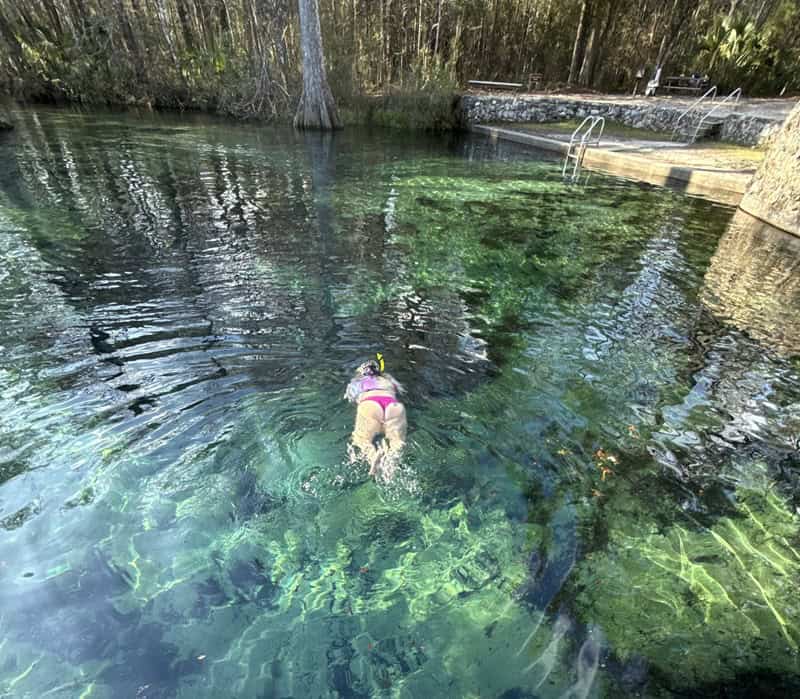

The Jumping Platform at Ponce de Leon Springs State Park
The concrete jumping platform at Ponce de Leon Springs State Park is a historic, low-lying concrete diving ledge built directly into the retaining wall along the deep end of the main spring basin. Dating back to when the site operated as a local swimming hole in the 1920s, it remains one of the park’s most popular features for visitors taking the plunge into the brisk 68°F water.

Layout & Design
- Position Over the Vent: The concrete platform extends slightly out over the deepest section of the spring head, where two underground water flows converge and pump roughly 14 million gallons of crystal-clear water daily.
- Low-Profile Height: Unlike tall wooden diving towers found at some other Panhandle springs (such as Wakulla Springs), the platform at Ponce de León sits just a couple of feet above the water’s surface, making it accessible and fun for both kids and adults.
- Surrounding Infrastructure: A concrete retaining wall wraps around the main swimming basin to prevent bank erosion, with integrated metal ladders and nearby limestone steps so swimmers can easily climb out after jumping.
Safety & Visitor Tips
- Slippery Surfaces. Because the concrete sits constantly damp in a shaded cypress forest, algae can build up along the edges—wear water shoes or watch your footing before jumping.
- No Lifeguards on Duty. Visitors swim and jump at their own risk, and while the center of the spring head is plenty deep for jumping, shallower ledges and submerged limestone rocks sit closer to the edges and steps.
- Cold Water Shock. Jumping straight off the concrete ledge into 68°F water is an instant shock on a hot summer day, so take a breath before leaping in
Take the cold-water shock tip seriously. It’s the coldest springs I’ve ever swum in. If I think it’s cold, you might think it’s freezing.
How Cold and Deep Is the Water At Ponce de Leon Springs?
The spring holds steady at 68 degrees Fahrenheit year-round. That’s cold enough to feel like a shock on a humid August afternoon and cold enough that some swimmers stick to wading on milder days. The main spring basin is a convergence of two underground flows, and the water’s clarity makes it easy to judge depth as you move from the shallow edges toward the deeper boil area.
Florida springs maintain a constant temperature year-round because their water comes from the Floridan Aquifer, a deep underground limestone reservoir insulated from seasonal weather changes. The 4-degree difference between 72°F springs and 68°F springs comes down to latitude and the region’s average annual air temperature.

Why Is The Spring Temperature At Ponce de Leon Springs Colder Than Others?
- Deep Earth Insulation: Rainwater seeps through the soil and collects in the porous limestone of the Floridan Aquifer hundreds of feet underground. Thick layers of rock and earth shield this water from summer heat waves and winter cold fronts.
- Thermal Equilibrium: Because the water sits underground for years before bubbling up through a spring vent, it settles at the exact average annual temperature of the surrounding rock and soil.
- Geographic Latitude: Groundwater temperature mirrors a region’s average annual air temperature. Springs in North Florida and the Panhandle are naturally cooler than springs in Central Florida.
- Regional Averages: Ponce de León Springs State Park sits in the Florida Panhandle near the Alabama border, where the yearly average air temperature hovers around 68°F. Central Florida springs—like Rainbow Springs, Weeki Wachee, and Blue Spring—sit further south where the average annual air temperature is closer to 72°F.
- Aquifer Depth: In parts of North-Central Florida and the Panhandle, the aquifer sits closer to the surface. Shallower groundwater absorbs slightly less geothermal heat from deeper layers of the Earth, keeping springs like Ponce de León and Morrison Springs at a brisk 68°F.
Florida Springs Temperature Map

What Should Families Know About Water Safety?
Keep young kids within arm’s reach near the spring boil, where the bottom drops off and the current picks up. The cold water can catch children off guard, so easing in rather than jumping is safer. Lifeguards aren’t a given at every Florida spring park, so treat supervision as your responsibility, not something the park provides.
How Do You Plan a Visit To Ponce de Leon Springs State Park?
Ponce de Leon Springs State Park sits just off Interstate 10 in Ponce de Leon, making it one of the more convenient spring stops for anyone driving through the western Panhandle. Fees are modest, hours run through the standard Florida State Parks schedule, and the park gets noticeably busier in summer than in the cooler months.
Where Is the Park, and How Do You Get There?
The park is in Holmes County, just off I-10, which makes it an easy exit-and-swim stop rather than a long detour. Drivers coming from Destin or the coast should expect roughly an hour’s drive north. From DeFuniak Springs, it’s a short hop up the interstate, making it easy to pair the two into one day of driving.
What Are the Hours, Fees, and Facilities?
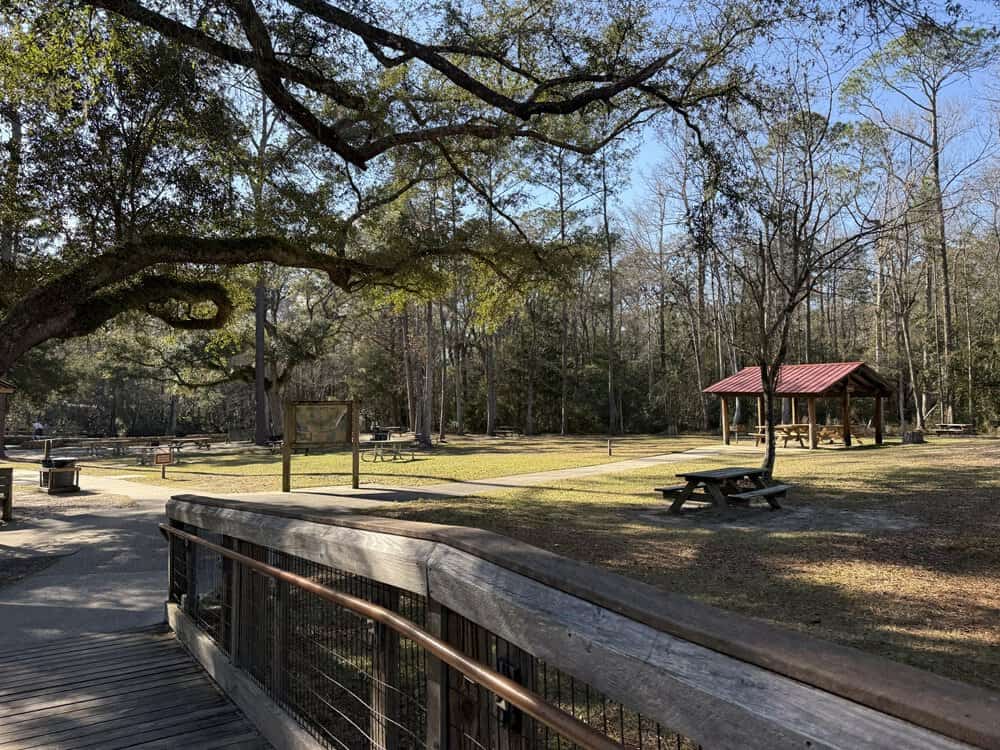
The park follows Florida State Parks’ standard hours and charges a modest per-vehicle entrance fee, with reduced rates for single-occupant vehicles, pedestrians, and cyclists. Facilities include restrooms, picnic areas, and a designated swimming area. Check the Florida State Parks website before heading out, since fees and hours can shift and the park occasionally posts alerts about water conditions or temporary closures.
When Is the Best Time to Go?
Weekday mornings in spring and fall are usually the quietest time to visit, before midday crowds and summer weekend traffic fill the parking lot. Summer brings the heaviest crowds, especially on weekends, since the cold water is the main draw during Florida’s hottest months. Winter visits are quieter, though the water temperature doesn’t change, so a cold front can make swimming feel like a bigger commitment than it does in July.
What Else Can You Visit Nearby?
Morrison Spring is a reasonable side trip for travelers who want to see another Panhandle spring with a different character, including its own swimming and paddling access. Florida Caverns State Park, further east near Marianna, adds a different kind of natural attraction with guided cave tours. Defuniak Springs itself is worth a stop for its historic downtown if you want a break from water activities.
What Makes the Park Worth Exploring Beyond the Water?
The park’s nature trails and plant life give visitors a reason to stick around even after they’ve dried off. Two short trails wind through the property, and the mix of pitcher plants and hardwood forest gives the walk some character beyond a simple loop.
The Sandy Creek Trail and the Spring Run Trail both follow the confluence of waters near the main spring, giving walkers a close look at the creek system that feeds into it. A separate tract south of Interstate 10 offers a two-mile loop connecting to a network of forest roads, which suits visitors looking for a longer walk than the main trails provide. None of these trails are strenuous, making them a good match for families looking to stretch their legs after swimming.

Pitcher plants grow in the park’s wetter, boggy areas, which surprises visitors who associate carnivorous plants with far-off swamps rather than a roadside Panhandle park. Gopher tortoises are another common sight along the drier trail sections. Hardwood trees and cypress shade much of the walking paths, keeping the trails noticeably cooler than the open parking areas.
Making the Most of a Spring Day Trip
Pack a mask and snorkel if you want to get the most out of the clear water, since the visibility here rewards a closer look below the surface. Bring water shoes too, since the sandy bottom near the boil can hide uneven spots. A picnic lunch works well if you plan to stay through the afternoon, and arriving earlier helps you beat both the crowds and the midday sun in the parking lot.
Check the Florida State Parks website ahead of time for current hours, fees, and any posted water alerts, since spring conditions can shift after heavy rain. Pairing this stop with Morrison Spring or a walk through Defuniak Springs turns a quick swim into a fuller day exploring this stretch of the Panhandle. For families road-tripping along I-10, this park works well as a mid-drive break rather than an all-day destination, though the trails give you a reason to linger if time allows.
Frequently Asked Questions
Is Ponce de Leon Springs State Park free to enter?
Entry isn’t free; the park charges a modest per-vehicle fee, with lower rates for single-occupant vehicles, pedestrians, and cyclists. Fees can change, so check the Florida State Parks website before your visit for the current amount.
Can you camp at Ponce de Leon Springs State Park?
Camping availability varies by Florida state park, and visitors planning an overnight stay should confirm current options directly through Florida State Parks before arriving. The park’s main draw is day-use swimming and trail access, not extended camping.
Are there alligators at Ponce de Leon Springs?
Alligators are generally part of Florida’s natural waterways, and visitors to any spring-fed park should stay aware of their surroundings. The swimming area here centers on a clear, actively used spring pool, and posted signage or park staff are the best source for any specific alerts about wildlife sightings.
Is Ponce de Leon Springs worth visiting?
It’s worth a stop for anyone driving through the western Panhandle who wants a cold, clear swim without a long detour off Interstate 10. Easy access, consistent water temperature, and short nature trails make it a solid midday road-trip break.
Is Ponce de Leon Springs the same as De Leon Springs State Park?
These are two different parks. Ponce de Leon Springs State Park sits in the Florida Panhandle near the town of Ponce de Leon, with 68-degree water, while De Leon Springs State Park is in Volusia County near DeLand, with 72-degree water and its own sugar mill pancake house.
Closing Thoughts
I would not return to this particular spring. The Panhandle has hundreds of hidden gems that are cold or outshine Ponce de Leon Springs. If you’ve never been, it is worth a visit; the spring run is very pretty and would be a great way to spend a sunny day. Aside from, nothing over special and I would not recommend taking the plunge.
Here are some of the most popular springs in Florida:
- Crystal River & Three Sisters Springs
- Homosassa Springs Florida
- Kelly Park – Rock Springs
- Kings Landing, Florida, and The Iconic Emerald Cut
- Rainbow Springs State Park
- Royal Springs – Suwannee County’s Hidden Gem
- Silver Glen Springs, Florida
- Silver Springs – One Of Florida’s Most Famous Springs
- Suwannee Springs, Florida – The Oldest Spring in Florida
Brit On The Move™ Travel Resources
Ready to book your next trip? Use these resources that work:
Was the flight canceled or delayed? Find out if you are eligible for compensation with AirHelp.
- Hotels: Find the best prices; use Booking.com
- Apartment Rentals: Find the best prices on apartment rentals with Booking.com’s Apartment Finder.
- Travel Insurance: Don’t leave home without it. View our suggestions to help you decide which travel insurance is for you: Travel Insurance Guide.
- Credit Cards: Check out our recommendations for Travel Credit Cards.
- Volunteer Vacation or a Working Holiday? Check out the complete guide here!
- Rental Cars: Find the best deals here!