Seminole Spring: The Tranquil Heart-Shaped Spring With Secrets
If you want a clear sense of what Seminole Spring is and why it matters, start with this: Seminole Spring is a natural freshwater spring system in Lake County, Florida, made up of multiple vents and ravines that produce clear, life-supporting water and offer easy access for recreation and observation. Privately owned and inaccessible by navigable water, Seminole Spring can be accessed by the public if you are staying on the property overnight at Camp Seminole.

This post may contain affiliate links. Please read our disclosure and privacy policy for more information.
One of my favorite things about this spring is that it is virtually on no one’s radar. Ask as many people as you like; few have even heard of this spring – myself included. I only discovered it while looking for an RV spot for the night on the route up to northwestern Florida. I’ll go into detail in the article, but I have to tell you up front: there’s a lot more to this small private spring than it appears.
About Seminole Spring – A Truly Private Spring With No Navigable Water Access
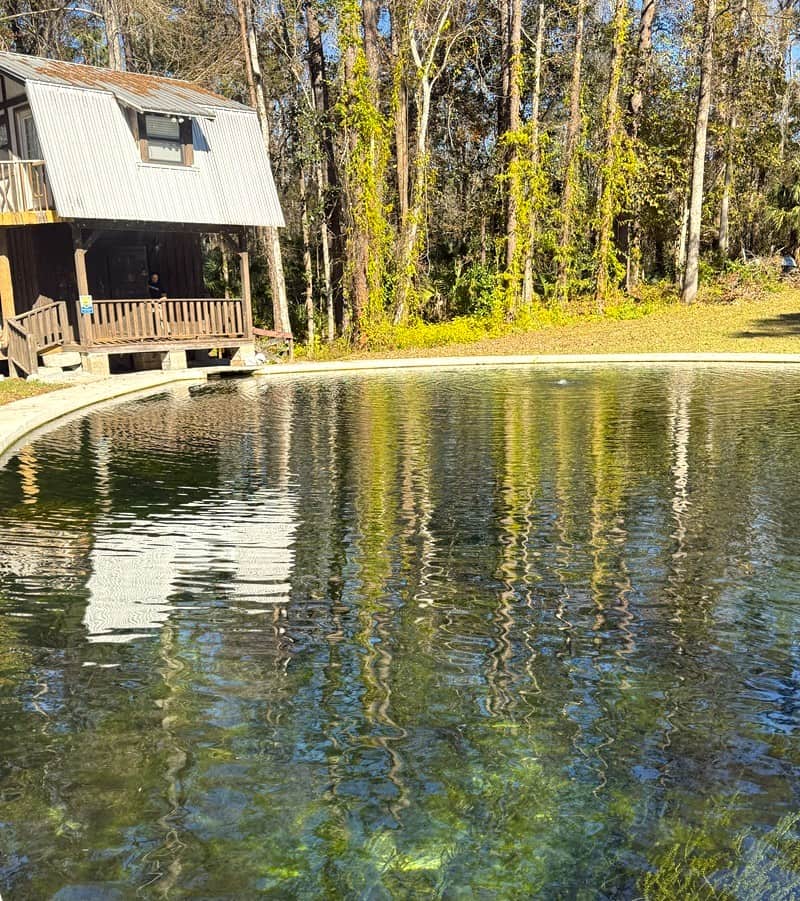
Seminole Spring is located inside Camp Seminole Spring. It is a fourth-magnitude spring with a heart-shaped pool about 115 feet long by 90 feet wide, enclosed by a concrete wall. Clear water issues from a 4-foot-wide sand boil on the west side of the pool at the end of the dock.
The springs and camp area were developed back in the 1940s as a honeymoon resort and campground centered around a distinctive heart-shaped spring pool. The spring pool and surrounding property later evolved into a recreational camping facility with rustic lodging, nature trails, and access to Orange Creek.
No boil was visible on the pool’s surface. It is believed to be man-made. A working gristmill adjacent to the spring pool marks the outlet to the spring run, which flows north about 0.2 miles to Orange Creek. A well is used to supplement the flow.

A gristmill is a facility or machine that grinds cereal grains (like wheat, corn, or oats) into flour or animal feed. The word “grist” refers to the grain brought in to be ground. Historically, these mills used waterwheels, wind power, or animals to turn heavy millstones.
After its initial resort phase, the property was used by organizations such as the Girl Scouts for camping and outdoor programs before becoming the private campground it is today.
The property also has several other smaller springs in Orange Creek that flow from the hillside overlooking the creek’s floodplain.
Florida Springs Etiquette – Leave No Trace Behind
It’s everyone’s right to visit Florida Springs. However, we all have a moral duty to leave them as we found them or better for others to enjoy. Here are some simple steps to ensure that our springs are kept pristine:
- Plan Ahead & Prepare: Know regulations (like springs protection zones), check the weather, and have appropriate gear.
- Travel & Camp on Durable Surfaces: Stick to trails; avoid creating new paths.
- Dispose of Waste Properly: Pack out everything (trash, food scraps, cigarette butts).
- Leave What You Find: Take photos, not plants, rocks, or shells.
- Minimize Campfire Impacts: Use designated rings and ensure fires are cold and out.
- Respect Wildlife: Observe from a distance; do not feed animals.
- Be Considerate of Others: Keep noise down and remove all personal items (chairs, toys, kayaks) daily.
Specific Florida Springs Actions
- In the Water: Don’t stand on vegetation or kick up silt; use mushroom anchors instead of hooks; trim boat motors in shallow areas; avoid landing boats on banks.
- On Shore: Fill holes in the sand; don’t climb trees or use rope swings.
- Boating: Turn off propellers when waiting for swimmers to pass to protect vegetation and wildlife.
Go The Extra Mile
- Pick up any trash others left
- Report any violators
- Report any distressed wildlife
About Seminole Spring
Seminole Spring is classified as a second-magnitude spring, meaning its average discharge falls within a specific flow range typical for springs of that designation. Its flows feed local wetlands and influence water levels in adjacent swamp and lake systems, including the periphery of Lake Apopka. The spring pool can appear milky white during late evening and early morning, a change attributed to sulfur-reducing bacterial activity; direct sunlight typically returns the water to a clearer appearance.
You can see from this picture that Seminole Spring is not necessarily as blue or clear as other springs. However, the spring vegetation is why it does not appear glass-like. Having stayed here myself, I can assure you it is clear; it just has dense vegetation. I will also tell you that while the spring itself is not the prettiest of them all, what lies behind it is stunning.

For travelers who truly wish to connect with nature, Camp Seminole Spring is ideally situated in the center of Orange Springs, Florida, between Ocala and Gainesville.
Water Quality
Seminole Spring’s water quality depends on groundwater flow from the Floridan aquifer and land-use influences across the recharge area. You can monitor conductivity, temperature, dissolved oxygen, and nutrient concentrations to assess health.
Elevated nitrate and phosphorus levels from fertilizer, septic systems, and stormwater can trigger algal growth that shades out submerged vegetation. You will see monitoring programs measure chlorophyll, turbidity, and fecal coliform to detect these issues early.
Staying At Seminole Spring
Remember, this is a private spring. The only way you can explore is to stay on site. You can only book a stay at Seminole Spring via Hipcamp. There are several types of accommodation:
A Camping Spot
There are 38 acres of camping sites and nature trails for hiking and mountain biking. There are approximately 103 camping sites. Some have RV hookups, and some do not. Camping reservations start at $39 per night.
Glamping Tents
These tents are essentially a ready-made base. They are unfurnished, but the advantage is you have no setup at all. These are beautiful, power-equipped, waterproof tents on raised platforms with carpeted floors. All three of the glamping tents face the spring. The glamping tents start at $72.

Rent The Gristmill
Had I known the gristmill was an option, I would have chosen it even though we were in an RV. I’ve since tried to book it, and I have not found a date that works – yet.
You can also rent the Grist Mill! This rustic, romantic retreat also has a half-bath. Incredibly private and isolated, with views of the waterfall on one side and the spring on the other. Enjoy the sights and sounds of nature while sitting on the deck. At night, the sound of the waterfall will put you to sleep. The Lodge bathhouse is where you can find the shower. If you want to rent the gristmill, you have to call or email to secure a reservation. The price for the rental is not disclosed online.
This is the inside view of the balcony that overlooks the spring:

Imagine this is your backyard view:

Rent A Room In The Lodge
For those who want a little more than glamping but not quite the full hotel experience, there are also three units inside the lodge. These are lovely, cozy rooms with half-baths. The lodge bathhouse is where the showers are located. There is the Honeymoon Suite, the Jungle Themed Room, and the Equestrian Themed Room. Every unit has its own hot tub to enhance the ambiance.

Just like the gristmill, you have to call or email the owners to book a room in the lodge.
Facilities On Site At Seminole Spring
Parking is available next to your site. Shared restrooms are available at the main lodge, and the owners will provide you with firewood, assuming there is no fire ban in place.
The lodge also serves as a social gathering point; the glorious main hall has a pool table, televisions, and board games. Perfect in case of rain.

Recreational Activities At Seminole Spring
Naturally, for anyone glamping, camping, or just staying, the two main attractions are the spring itself and the grounds.
You can swim in Seminole Spring; the temperature is the same as all the others: 72 degrees, like all others below Tallahassee. You can snorkel in the spring as well, but visibility is not the same as in others. This spring has heavy vegetation.
You can hike, and I strongly recommend following the trail behind the gristmill to the Orange Creek – this is what awaits:
When I return, I plan to claim this slice of the Orange Creek with a couple of chairs and relax for the day. I stayed in January, so I can’t say what the bugs will be like in the summer. But if they are like other springs buried deep in the woods, I would expect there to be horse and deer flies.
You can choose from short interpretive loops to longer multi-use trails that run along wetlands and hardwood hammocks. Trails typically include clear signage, boardwalks over marshy sections, and occasional benches for resting and birdwatching.
Wear sturdy shoes and bring insect repellent during warmer months; sections near open water can be muddy after heavy rain.
The Bridge Over Orange Creek
I don’t know what this bridge is actually called. The owner told us that this bridge connects his land to the land retained by the Girl Scouts. It’s well signposted as private property, but you can walk over the bridge.

Fishing Opportunities
You can fish from the shoreline of Orange Creek. Common catches include bass, sunfish, and catfish depending on season and habitat. Follow Florida state fishing regulations: you must carry a valid freshwater license as required and observe size and bag limits.
Photography Opportunities
As I explored the trails at Seminole Spring and followed the winding path of Orange Creek, I noticed that many trees were down. Almost all seem to connect from one side of the creek to the other.
My immediate thought was Dirty Dancing! I know I’m not the only person who sees trees like this and thinks this. Google the scene, and you’ll find tons of people’s attempts to recreate it.

Now, I didn’t attempt this. My friend was too concerned about potential alligators, but I might give it a shot when I return. For those of you who love photography, the creek has a plethora of opportunities for you – here’s an example:

How To Get To Seminole Spring
Address: 12695 NE 244 St, Fort McCoy, FL 32134
Closing Thoughts
If you are looking for a spring you can kayak, canoe, or boat on, this is not the one. If you are looking for a spring free of vegetation and with water so clear it looks like glass, this is not the one for you.
If, like me, you are willing to trade turquoise blues and greens for a sandy bottom creek and a lack of crowds, this is the place for you!
I also think Seminole Spring is particularly interesting because it’s privately owned. I can’t tell you how often I get asked about privately owned springs and how to access them – it seems to be something we are all fascinated with.
Do yourselves a favor and make it a point to visit Seminole Spring – you won’t regret it.
Looking For More Springs?
- Convict Spring, Florida: The Rich History & Enchanting Attractions
- Devil’s Den, Florida – A Prehistoric Spring
- Fanning Springs: The Ultimate Visitor’s Guide
- Florida Springs Kayaking Guide
- Hightower Spring: One Of Florida’s Most Enigmatic Hidden Gems
- Kings Landing, Florida, and The Iconic Emerald Cut
- Manatee Springs Park: A Tranquil Paradise Awaits
- Mud Springs, Florida: Discover This Hidden Gem!
- Rainbow Springs State Park
- Royal Springs – Suwannee County’s Hidden Gem
- Sulfur Spring in Welaka State Forest
- Wakulla Springs and Lodge
- Weeki Wachee Springs
- Wes Skiles Peacock Springs State Park
Brit On The Move™ Travel Resources
Ready to book your next trip? Use these resources that work:
Was the flight canceled or delayed? Find out if you are eligible for compensation with AirHelp.
- Hotels: Find the best prices; use Booking.com
- Apartment Rentals: Find the best prices on apartment rentals with Booking.com’s Apartment Finder.
- Travel Insurance: Don’t leave home without it. View our suggestions to help you decide which travel insurance is for you: Travel Insurance Guide.
- Credit Cards: Check out our recommendations for Travel Credit Cards.
- Volunteer Vacation or a Working Holiday? Check out the complete guide here!
- Rental Cars: Find the best deals here!