Ginnie Springs: The Most Overhyped Springs and Why I Strongly Dislike Them
Whenever I see content related to Ginnie Springs, I automatically roll my eyes. Aside from the fact that it’s probably the most publicized spring in Florida and potentially the most well-known, it is my least favorite of all – and by a long shot. I know that those who love Ginne Springs will violently disagree, and that’s totally fine. It has some features worth visiting. It’s also a spring that all spring lovers should experience at least once. But I hate it, and you’ll never convince me otherwise.
Ginnie Springs is a commercial nightmare up there with Disney. It’s privately owned, operated as a for-profit recreation area, and seems to be an “influencer” favorite. Then there’s the fact that the family that owns it also conveniently owns a water bottling company, and bingo – you’ve got the classic legal scam – individuals profiting off of natural resources.
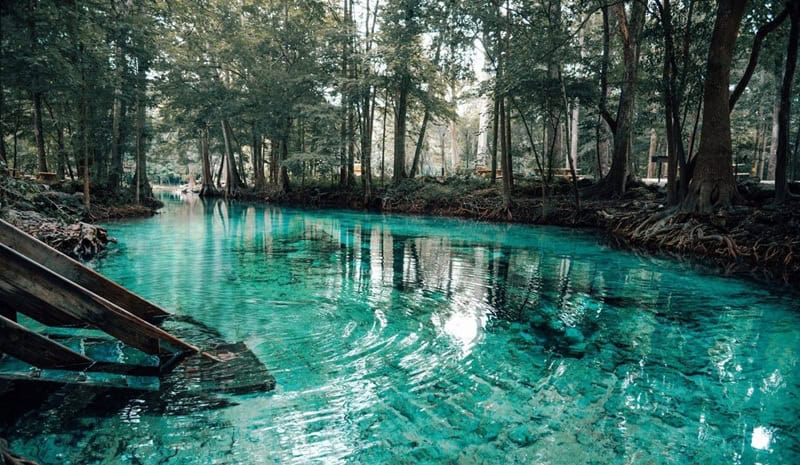
Time and time again, you’ll see pictures like the one below this showing various spring heads or caves within the Ginnie Springs complex. Typically, a solo person sitting on a paddleboard or a solo person in a strategic pose at the bottom of the steps. Implying this is a remote or lesser-known spring you can enjoy on your own.
As beautiful as Ginnie is, your chances of seeing Ginnie Springs like this are slim at best. That is, unless you are willing to be one of the first to enter or to camp on-site throughout the week in cooler weather.
This post may contain affiliate links. Please read our disclosure and privacy policy for more information.
Ginnie Springs Background And Ownership
Ginnie Springs is privately owned by the Wray family, who have controlled the property since the early 1970s. The land and springs are operated by Ginnie Springs Outdoors, LLC. The family still owns the surrounding acreage (hundreds of acres along the Santa Fe River) and manages it as a commercial recreation park. The family also held rights to sell spring water, supplying companies, including major bottled water operations, for decades.
The Wray family, led by developer Bob Wray, acquired the land surrounding Ginnie Springs in 1971. The family purchased the property from Ed Wright, a major Florida landowner. After buying it, the family developed it into a recreational site and officially opened it to the public in 1976. By 1980, they had turned it into a major scuba-diving destination, adding safety features and facilities. Since then, it has grown into one of Florida’s most popular spots for tubing, camping, and diving. And later established the Seven Springs Water Company to manage the land and its water resources.
The Wray family has focused on maintaining recreational access while managing camping, tubing, and diving operations. Over time, the site added amenities such as marked dive entries, rental equipment, boat launches, and established cave-diving rules to balance visitor use with safety and environmental protection.
Wray Family Bottling Operations
The Wray family held the bottling permit for more than 25 years because Ginnie Springs was privately owned. Numerous businesses, including Coca-Cola, purchased the water from the spring. The Suwannee River Water Management District Governing Board authorized a permit in 2021 that allowed Nestle to increase its bottled-water operations by drawing more than 1.1 million gallons per day from the aquifer that supplies Ginnie and other neighboring springs.
There has been an outcry over this. Environmentalists opposed the permit’s issuance on the grounds that it would worsen the state’s natural springs and rivers, among other reasons, including endangering minimum flow levels, causing ecological damage to the land and rivers, and aggravating already-stressed springs. These issues reflect broader concerns that increased water extraction could exacerbate existing environmental pressures in spring systems.

Members of Our Santa Fe River protest the permitting of Seven Springs to sell water from Ginnie Springs to Nestle in Live Oak on Tuesday, Feb. 24, 2020. Image Credit: Our Santa Fe River.
There have been countless protests against this. Last Update: On May 10, 2023, the hearing was held in the Division of Administrative Hearings. Administrative Law Judge (ALJ) Francine Folkes decided in Seven Springs Water Company’s favor in October of 2023. On December 12, 2023, the permit was subsequently approved by the SRWMD.
The Ginnie Springs permit is operated by Seven Springs Water Company, which pays the state of Florida a one-time application fee of just $115 in exchange for the ability to pump more than a million gallons of water every day. There are no recurring yearly expenses to the state for the amount of water extracted, and the water itself is free.
Read this again! $115 a year to extract millions of gallons of water, which is then sold to Nestle. I think anyone with half a brain cell can see the obvious controversy in this. It’s a state resource that the state collects $115 from, yet Seven Springs Water Company and Nestle make millions from it. Yes, Seven Springs Water Company claims this money is used to maintain the springs’ health, and some of it likely is. But let’s not forget that Seven Springs Water Company is owned by the Wray Family, which also owns Ginnie Springs Outdoors, LLC. Ginnie Springs Outdoors, LLC makes millions a year from the park, more than enough to “maintain” the spring.

The irony of this history is bittersweet for me. I often get a ton of hate for writing about and sharing Florida’s springs. The main complaint people have is that “tourists,” loosely defined as anyone not “native” or “local” visiting a spring, do not respect the spring and leave trash.
I can tell you firsthand, this is a load of bollocks. I’ve been to many lesser-known springs, and not only do I scan vehicles for rental cars, but I also assess, document, and remove the trash. I’ve yet to go to a spring like Telford or Charles and see a “tourist” or a non-Floridian, which I can only assume are locals. Yet here we have a privately owned spring system being exploited, and no one blinks an eye. Go figure.
I could write for hours on the conflicts that all springs face, but I’ll leave it to you to do some more research if you are interested in the real threats to springs. It’s not just the water pumping; it’s the pollutants and the politicians who all have their hands in the pockets of corporations, not the average person.
Exploring Ginnie Springs
Ginnie Springs features seven distinct natural, crystal-clear springs. Here are the key springs at Ginnie Springs:
- Ginnie Spring: The main, largest spring.
- Devil’s Spring System: Includes Devil’s Eye, Devil’s Ear, and Little Devil.
- Dogwood Spring.
- Twin Spring.
- Deer Spring.
Map Of Ginnie Springs

As you can see, Ginnie Springs is a large complex with multiple springs, all of which are surrounded by the Santa Fe River. Ginnie Springs offers clear, 72°F water, multiple spring vents, and direct access to the Santa Fe River.
Snorkeling and Swimming
Aside from the controversy that surrounds Ginnie Springs, it is home to some of the clearest water you’ll ever swim in. You can snorkel right from the main spring heads where visibility often exceeds 30–50 feet.

Scuba Diving
Ginnie Springs is a well-known dive site with caverns and cave systems accessible to certified divers. If you’re cave-certified, plan dives into mapped passages; recreational dives usually focus on large underwater chambers and the spring vents. Local dive shops run guided tours and air fills; book in advance on weekends and holidays. Surface support is limited in some areas, so have a dive buddy and a clear plan for entry, exit, and emergency ascents.
Photography
Given the water clarity, Ginnie Springs is often chosen for filming. It’s not just “influencers” that pick Ginnie Springs; many others do, especially divers. I participated in a photography shoot at Ginnie Springs, testing out underwater commercial diving lenses. Here’s the end result:

Tubing Adventures
Tubing the Santa Fe River from Ginnie Springs starts at the park’s launch points and follows a mostly gentle current with scenic cypress-lined banks. Tube rentals and shuttle services operate on busy days; verify hours and shuttle schedules before you go. Plan a two- to four-hour float depending on river conditions and your chosen exit point.

Camping and Accommodations
Ginnie Springs offers tent and group sites across roughly 200–290 acres, many of which are located along the Santa Fe River and its springs.
Tent Camping
Tent sites range from shaded, wooded spots to open riverfront choices; most include a picnic table and grill. You can reserve single sites or group areas for gatherings; group areas accommodate organized outings and can be best for larger groups who want proximity to the springs. Vault toilets, outdoor showers, and centralized potable-water stations serve the camping loops, so bring a water jug for your site. Consider booking early for summer weekend dates—sites fill up fast during peak season.
RV Facilities
The park provides numbered RV sites with at least water and electric hookups; a subset of sites offers full hookups. Sites include picnic tables and grills and are placed to balance privacy with access to park facilities. The grounds accommodate a range of RV lengths, but confirm the available site length when you book to ensure a good fit. Dump stations and laundry facilities are available on-site, reducing the need to leave the park for basic RV services. Power hookups are typically 30A or 50A; bring appropriate adapters and heavy-duty extension cords. Expect gravel pads and shaded spots near the tree line rather than paved, full-service resorts.

Ginnie Springs Ticket Pricing and Reservations
Ginnie Springs pricing in 2026 is structured around day-use admission, per-person camping fees, and separate equipment rentals, with rates varying by season and usage type.
Note: If you have your heart set on visiting Ginnie Springs, I strongly recommend you reserve your spot online in advance. This applies to day passes and camping. You must also complete a waiver to enter Ginnie Springs, which can be done online in advance.
Day Passes To Ginnie Springs
Day pass admission during peak season (March through October) is typically $25 per adult, while off-season rates (November through February) drop to around $20. Children ages 4 through 12 are charged approximately $6 during peak season and $5 in the off-season, while children under 3 are admitted free. These passes allow access to all springs, the Santa Fe River, and general-use amenities such as picnic areas and walking paths, and they are valid only until sunset. Specialized entry for divers costs more: cave-certified divers pay about $28, while recreational divers pay closer to $36.
Camping Cost At Ginnie Springs
Camping is priced per person rather than per site, which is an important distinction compared to most public campgrounds. During peak season, adult camping costs about $40 per person per night, while off-season rates drop to around $30. Children ages 4 through 12 typically pay $10 per night in peak season and $8 off-season, with younger children again free.
Primitive camping is included in this base rate and is first-come, first-served, allowing visitors to camp near the springs, river, or wooded areas. For those needing utilities, water, and electric hookup sites are available for an additional fee of approximately $15 per night per site, while larger group hookup sites can cost around $30 per night. RV camping follows the same structure, with no separate base rate beyond the per-person fee, though hookups add to the cost. On busy weekends and holidays, minimum-stay requirements, such as two-night bookings, are often enforced. Camping fees include park admission, so no separate day pass is required.
Rental Equipment at Ginnie Springs
Rental pricing varies by duration and demand, but typical 2026 rates include tube rentals at $10 to $15, kayaks and canoes at $15 to $30 per hour, and paddleboards at $20 to $40. Snorkeling and diving equipment is also available at higher rates depending on the level of gear required.
- A standard day trip for one adult, including a tube rental, usually totals between $35 and $40.
- A two-night camping trip during peak season typically costs around $80 per person for primitive camping, or approximately $110 per person when adding electrical and water hookups.
On-Site Store
The on-site store stocks essentials: bottled water, snacks, sunscreen, basic first-aid items, and replacement swimwear or towels. You can also buy tubing accessories, disposable phone pouches, and limited camping supplies, such as lantern fuel and propane canisters. The store accepts cash and major cards; during peak times, lines can form, so pick up supplies early in the day. Staff can answer questions about trail access, restroom locations, and where to return rented equipment.

Best Time To Visit Ginnie Springs
This is the most common question I get for any spring. My standard answer to all is throughout the week – avoid weekends at all costs. However, Ginnie is a special case. If you don’t mind the crowds, you’ll do just fine in the summer. If you want to avoid crowds, the best time to visit is from November to March, when the weather is colder. The other option you have is to get there at opening time; just know the crowds will follow.
Why I Strongly Dislike Ginnie Springs
I already covered one of my dislikes about the park in the history: it’s a privately owned, for-profit, commercial park that allows water pumping for profit. Let me address other things that put Ginnie Springs at the bottom of my list:
- It’s one of the most expensive springs to visit in Florida. Daily admission is over $20, and camping is charged per person.
- It gets packed, think bumper to bumper only in the water. Even on the Santa Fe River, you’ll be bumping into others.
- Ginnie Springs is known for its relaxed policies compared to those of state parks. For example, until recently, you could take a cooler of alcohol on the water, glass bottles, and so on. This has recently changed, and you can only drink at camp sites.
- Over a holiday weekend, Ginnie Springs gets approximately 200,000 visitors. There is absolutely nothing remote or scenic about this.
- Somehow, Influences have singled out Ginnie Springs as one of the “best”. I can’t really wrap my head around this. My guess is that they don’t live in Florida or have not visited enough to know one from another.
- There have been several fatal incidents at the park over the last few years. One holiday weekend alone resulted in 74 calls to the local police department.
Crowds are not my cup of tea. Loud noise, engines revving, and people hurling themselves all over is just not for me.
Reality Vs. Media
These pictures speak for themselves. Imagine you’ve been dreaming of a tropical oasis, a place to spend a day exploring the water and nature. This is the reality:


Frequently Asked Questions
How do I make a camping reservation, and what are the campground rules?
Make camping reservations online through Ginnie Springs’ official website or by phone; some sites fill weeks in advance for summer weekends. Provide your vehicle and party information, and confirm campsite type (primitive, electric, or group) when booking.
What activities are available on-site, and what equipment can be rented?
You can tube, swim, snorkel, kayak, paddleboard, and scuba or cave dive at Ginnie Springs. The Santa Fe River offers tubing and paddling routes; multiple springs and swim areas suit snorkelers and swimmers.
On-site rental options often include tubes, kayaks, and paddleboards; scuba gear may be available through local dive shops rather than directly from the park. Bring or rent appropriate gear and confirm rental availability and fees before arrival.
What waivers or forms are required before entering or participating in activities at Ginnie Springs?
Ginnie Springs requires a liability waiver or signed agreement for entry, especially for day-use and camping. You may need separate waivers or dive registration forms for scuba or guided dives. Bring a valid photo ID and any medical or emergency-contact information staff may request. If renting equipment, expect a rental agreement and a credit card hold.
Closing Thoughts
It is true that Ginnie Springs offers miles of unmatched underwater visibility and a phenomenal cave system – there is no denying it. For me, it’s far too commercial. Not just from the sheer volume of visitors it receives, but also the controversy that surrounds it.
Looking For More Springs? Start Here:
- Eagles Nest Sinkhole: A Wonderful And Iconic Sinkhole
- Homosassa Springs Florida
- Kings Landing, Florida, and The Iconic Emerald Cut
- Rainbow Springs State Park
- Royal Springs – Suwannee County’s Hidden Gem
- Suwannee Springs, Florida – The Oldest Spring in Florida
- Telford Springs: A Natural Wonder On The Suwannee River
- Troy Springs: A Guide to Florida’s Stunning Natural Wonder
- Wes Skiles Peacock Springs State Park
Brit On The Move™ Travel Resources
Ready to book your next trip? Use these resources that work:
Was the flight canceled or delayed? Find out if you are eligible for compensation with AirHelp.
- Hotels: Find the best prices; use Booking.com
- Apartment Rentals: Find the best prices on apartment rentals with Booking.com’s Apartment Finder.
- Travel Insurance: Don’t leave home without it. View our suggestions to help you decide which travel insurance is for you: Travel Insurance Guide.
- Credit Cards: Check out our recommendations for Travel Credit Cards.
- Volunteer Vacation or a Working Holiday? Check out the complete guide here!
- Rental Cars: Find the best deals here!