Crystal River Archaeological State Park – Discover the Fascinating Legacy and Ancient Echoes of the Estuary
Crystal River Archaeological State Park, spanning a modest 61 acres, preserves a monumental complex that served as an anchor for indigenous culture, trade, and spirituality for nearly two millennia. Designated a National Historic Landmark in 1990, this network of shell mounds, expansive plazas, and ancestral burial grounds stands as one of the longest continuously occupied indigenous sites in Florida.
Unlike many prehistoric nomadic settlements, the village at Crystal River grew into a prominent, multicultural ceremonial center. Long before European explorers arrived on the peninsula, it drew an estimated 7,500 travelers annually. These travelers crossed vast distances across the continent to trade prized regional resources, honor their dead, and participate in astronomical rituals.
I’ve been a part-time resident of the Crystal River for over fifteen years, and shame on me. I only discovered the Crystal River Archaeological State Park in 2026 and by pure accident.

This post may contain affiliate links. Please read our disclosure and privacy policy for more information.
The Ecological Foundation of an Ancient Metropolis
The emergence of a large, sedentary community at Crystal River around 500 B.C. was driven by environmental changes. Geologists and archaeologists note that during the late Holocene epoch, roughly 6,500 years ago, shifting sea levels stabilized, forming the Gulf Coastal Lowlands and its complex marine estuaries. The park itself sits atop the Pamlico terrace—a flat plain of limestone covered by a thin layer of sand, coquina, and rich estuarine sediments.
For early humans, this maturing estuary was a natural wonderland. The mixing waters of the river provided an abundance of fish, crabs, and turtles, while the shallow, intertidal mudflats yielded an endless harvest of oysters, clams, and bay scallops. This reliable marine buffet eliminated the need for constant seasonal migration, allowing the early inhabitants to establish permanent roots along the riverbanks. Over generations, the discarded remnants of these daily meals—millions of tons of mollusk shells—gradually transformed from simple garbage piles into the structural foundation of a monumental engineering project.
Architectural Layout of the Mounds At Crystal River Archaeological State Park
The Crystal River Archaeological State Park features six prominent architectural earthworks, each built to fulfill specific social, domestic, or religious functions within the community.
Mound A: The Great Temple Mound
Standing 29 feet tall near the riverbanks, Mound A is the highest point of relief in the low-lying coastal landscape. This structure contains over 300,000 cubic feet of hand-carried shells, a project that experts estimate required more than 250,000 individual basket loads and roughly two decades of continuous construction.

A modern 51-step wooden staircase ascends the slope today, allowing visitors to stand on the exact summit where ancient leaders once looked out across the salt marshes. Rather than a simple residence, the flat summit served as a public stage for religious ceremonies, elite political speeches, and seasonal celebrations visible to thousands of onlookers gathered below.
The views from Mound A at Crystal River Archaeological State Park are indescribable. I’ve seen the Crystal River from many angles; this one was new to me. You can see all of the estuaries flow together, see all of the marsh, and if you visit at sunset, you’ll experience one of the best views of the Crystal River.

The Main Burial Complex (Mounds C–F)
This central feature is a circular mound surrounded by a protective shell embankment. It served as the final resting place for more than 1,500 everyday citizens over several centuries. The deliberate layering of graves demonstrates a deep cultural focus on ancestor veneration, with successive generations laid to rest in an architectural monument to the community’s shared heritage.

Mound G: The Sand Burial Mound
Mound G stands as a flat-topped cone near the riverbanks, but its interior differs significantly from the surrounding shell-heavy structures. Excavations revealed that this mound was primarily built of sand and reserved exclusively for high-status individuals.

The 400 graves found inside contained exquisite burial gifts, indicating that those interred here held significant political or religious status within the community.
Mound H and the Central Plaza
Directly adjacent to the open public plaza sits Mound H, a 12-foot-tall, flat-topped platform. The plaza itself was kept clear of daily refuse, functioning as a civic town square where visitors and locals gathered for games, markets, and sacred dances overseen by dignitaries stationed on the mound.
Chronology and Material Culture Of Crystal River Archaeological State Park
The long history of Crystal River is divided into three distinct pre-Columbian cultural periods. Each period is defined by shifts in artistic styles, burial customs, and technological progress:
- The Swift Creek Period (200 B.C. – A.D. 300): This era marked the initial construction of the burial complexes and the rise of a widespread trade network. The defining artifacts of this time are pottery vessels decorated with intricate geometric and stylized animal designs stamped directly into damp clay using carved wooden paddles.
- The Weeden Island Period (A.D. 300 – A.D. 1300): During this phase, ceremonial life reached its peak. Craftsmanship shifted toward elaborate, puncture-decorated pottery, animal-shaped effigy pipes, and specialized vessels designed solely for ritual use rather than daily cooking.
- The Safety Harbor Period (A.D. 1300 – A.D. 1400): In its final century, Crystal River adopted the political styles of the Mississippian cultures, which were expanding across the American Southeast. This period brought a greater focus on platform mounds, rigid social hierarchies, and new agricultural practices, shortly before the site was mysteriously abandoned.
Archaeologists rely heavily on the fragments left behind in the residential shell middens to reconstruct the details of daily life. While plain, sand-tempered utilitarian pottery dominates the kitchen refuse heaps, the presence of limestone-tempered Pasco plain pottery reveals regular family and marriage ties with inland Florida communities.
A Continental Trade Junction
One of the most remarkable discoveries from the Crystal River Archaeological State Park is the sheer volume of exotic goods unearthed during excavations. The artifacts reveal that this remote Florida estuary was connected to a massive trade network that spanned thousands of miles across North America.
Among the high-status items discovered within Mound G were:
- Copper Breastplates and Ear Spools: Hammered from raw ore mined in the Great Lakes region.
- Galena Crystals: A reflective lead ore transported from the mines of present-day Missouri.
- Meteoric Iron Ornaments: Crafted from rare meteorite fragments found in the Ohio River Valley.
- Stone Effigy Pipes: Sculpted in the likeness of local wildlife by artisans from distant northern cultures.

These discoveries show that Crystal River did not develop in isolation. Instead, it functioned as a major southern destination for the Hopewell Interaction Sphere—a continent-wide network of trade and shared religious ideas. Local residents likely traded valuable coastal resources such as shark teeth, conch shells, salt, and preserved marine oils for these exotic northern materials.
Solar Calendars and Limestone Stelae
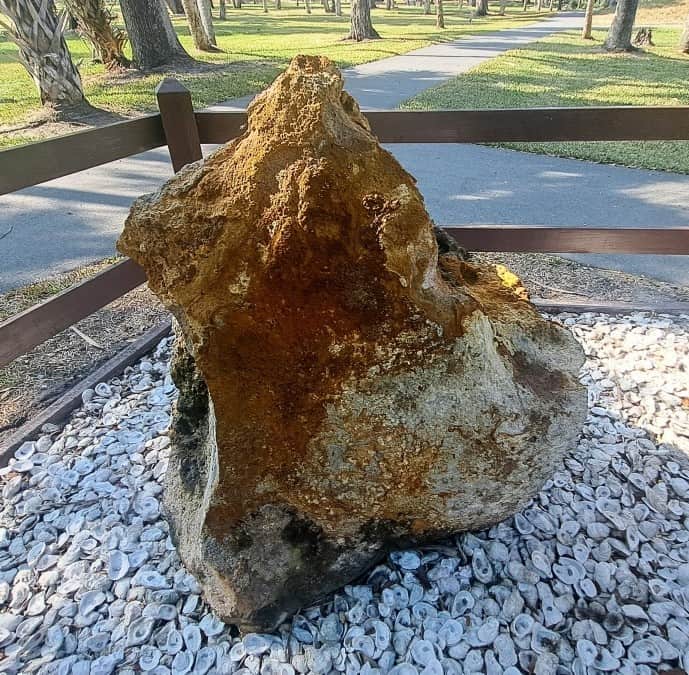
Beyond its role as a trading hub, Crystal River was a center for early astronomy. In 1964, archaeologists uncovered a unique feature near the main burial complex: a large, upright limestone slab known as Stele 1. Carved with a faint human face, feathers, and geometric patterns, this monument is unique as the only known stone stele of its kind in the southeastern United States.
Subsequent studies revealed that Stele 1 was not just a decorative monument. When viewed from the summit of Mound A, Stele 1 aligns precisely with the horizon where the sun sets during the winter solstice. This architectural alignment allowed ancient priests to track changing seasons with pinpoint precision, providing a reliable calendar for scheduling important religious festivals, harvest gatherings, and communal trade markets.
Modern Recovery, Demolition, and Preservation
The scientific history of Crystal River began in 1903, when wealthy amateur archaeologist Clarence B. Moore anchored his steamship, the Gopher, in the river. Moore spent weeks excavating parts of the burial mounds, uncovering many of the spectacular copper and pottery artifacts now housed at the Smithsonian Institution.
Tragically, because the site lacked formal legal protection during the early 20th century, it suffered severe industrial damage. In the 1950s, a local developer purchased a portion of the property and used heavy machinery to bulldoze several shell ridges and the front half of the platform mounds, creating fill dirt for a waterfront seawall.
Recognizing the imminent loss of this irreplaceable historic treasure, the state of Florida stepped in to purchase the remaining 61 acres, opening it as Florida’s first official State Archaeological Site on August 6, 1962.
The Modern Visitor Experience At Crystal River Archaeological State Park
Today, Crystal River Archaeological State Park offers a peaceful, educational experience that transports visitors back to Florida’s ancient past.
The Museum and Mid-Century Architecture
A visit typically begins at the park’s museum, which opened its doors in 1965. Designed by architects David Reaves and Dan Branch, the mid-century modern building features a flat, stepped roofline that mirrors the shape of the ancient temple mounds outside. Inside, visitors can view interactive models of the ancient village, an intact prehistoric dugout canoe, and rows of recovered pottery fragments.

The Interpretive Trail
Outside the museum, a 0.75-mile paved trail winds through the shaded hammock and along the edge of the tidal marsh. Paved and fully wheelchair accessible, the path is lined with educational signs that explain the history of each mound, the layout of the old plazas, and the unique geology of the surrounding coast.
Birding and Coastal Fishing
Beyond its deep historical value, the park is an excellent destination for nature lovers. As an official stop along the Great Florida Birding Trail, the surrounding salt marshes and cabbage palm hammocks provide prime habitat for bald eagles, ospreys, clapper rails, and various wading birds. Visitors can also bring a fishing rod to the park’s shaded riverfront boardwalk, a popular spot for catching both freshwater largemouth bass and saltwater redfish.
Planning Your Visit To Crystal River Archaeological State Park
- Address: 3400 N Museum Point, Crystal River, FL 34429
- Hours: The park grounds are open daily from 8:00 a.m. until sunset. The museum welcomes visitors from 9:00 a.m. to 5:00 p.m., Thursday through Monday.
- Admission: Access to Crystal River Archaeological State Park is exceptionally affordable at just $3 per vehicle, payable via an on-site honor box or an online day pass system.
- Special Tip: For a truly memorable experience, plan a visit around the monthly full moon. The park hosts guided night tours where rangers lead visitors along the moonlit mounds, sharing ancient stories and discussing how early peoples used the stars to navigate.
If you are traveling through the Nature Coast, combining a morning walk along these historic mounds with an afternoon kayak trip through the nearby Crystal River Preserve State Park offers a wonderful way to experience both the rich history and beautiful natural landscapes of Florida.
Closing Thoughts
I cannot believe that after all my years visiting the Crystal River, I just discovered the Crystal River Archaeological State Park. I love history, and I consider myself fairly well-versed. Not knowing that we have an Archaeological State Park made me a little upset with myself – I should have known, but now I do.
You don’t need a whole day to explore Crystal River Archaeological State Park. If you just want to see the mounds, you need an hour or two. If you are doing the museum as well, add another hour. Or, plan to spend the whole day at Crystal River Archaeological State Park and enjoy the scenery.
Another notable aspect of Crystal River Archaeological State Park is that it opened Florida’s first official State Archaeological Site. This alone is a reason to go out of your way to visit Crystal River Archaeological State Park.
Looking For More?
- Captivating Convict Spring, Florida
- Eagle’s Nest Sinkhole: A Wonderful And Iconic Sinkhole
- Explore Ozello, Florida: One Of Florida’s Last “Channel-Less” Coastal Towns
- Fanning Springs
- Homosassa Springs Florida
- Kings Landing, Florida, and The Iconic Emerald Cut
- Rainbow Springs State Park
- Royal Springs – Suwannee County’s Hidden Gem
- Suwannee Springs, Florida – The Oldest Spring in Florida
- Telford Springs: A Natural Wonder On The Suwannee River
- Troy Springs: A Guide to Florida’s Stunning Natural Wonder
- Wakulla Springs and Lodge
- Wes Skiles Peacock Springs State Park
Brit On The Move™ Travel Resources
Ready to book your next trip? Use these resources that work:
Was the flight canceled or delayed? Find out if you are eligible for compensation with AirHelp.
- Hotels: Find the best prices; use Booking.com
- Apartment Rentals: Find the best prices on apartment rentals with Booking.com’s Apartment Finder.
- Travel Insurance: Don’t leave home without it. View our suggestions to help you decide which travel insurance is for you: Travel Insurance Guide.
- Credit Cards: Check out our recommendations for Travel Credit Cards.
- Volunteer Vacation or a Working Holiday? Check out the complete guide here!
- Rental Cars: Find the best deals here!